
Scatterometer Overview
An Overview of Scatterometers Available from TSW The following instruments are offered for sale by The Scatter Works, Inc (TSW). They vary greatly in both price and capability. User choices need to be dictated by user requirements. For example, all of the instruments can be purchased with different wavelength sources. This document is only an overview, but will help you narrow the search.
They are organized roughly in order of increasing price and capability. Use the summary chart on the next page. Call or email TSW to get more detailed information and/or quotes.
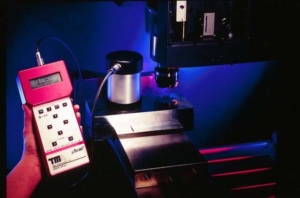 The MicroScan is a simple single diode laser three detector scatterometer manufactured by TSW. The system measures specular reflectance at an incident angle of 25 degrees and scattered light at angles of 0 and -50 degrees. Under the assumptions that the surface is optically smooth and isotropic values of the rms roughness from 0.01 to 1.0 Um-1 is reported. The noise floor is about 10-5/sr. It has been used to monitor the aging of large optics. Standard wavelengths include 450nm,532nm,650nm and 980nm.
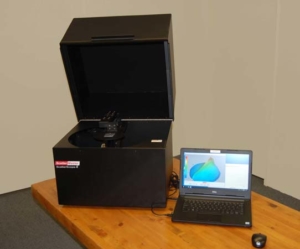 The ScatterScope4 is a table top instrument manufactured by ScatterMaster LLC in Tucson AZ. It uses multiple silicon detectors that scan 180 degrees to measure hemispherical and incident plane scatter in both reflection and transmission. It can be equipped with as many as three laser diode sources. It does not measure close to the specular beam and the noise floor is limited to the 10-5/sr to 10-6/sr range. It’s huge advantages are speed (15- 20 seconds per scan) and ease of use. Operators can be trained in a few minutes. It is an ideal instrument for the lighting industry. Call for quotes.
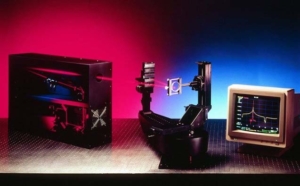
The CASI Scatterometer (below left) is a TSW research instrument that can be configured with multiple laser sources ranging from the near UV to the mid-IR. It uses programmable collection apertures and step sizes to allow measurements within 0.1 degrees from the specular beam or better and it has a noise floor of about 10-8/sr in the visible, which is limited by scatter from air molecules. It takes a linear incident plane scan at a programmable incident angle. It requires a lab with an optical table (not supplied) and benefits from hepa filter air flow for some applications. Operator training takes about a week.
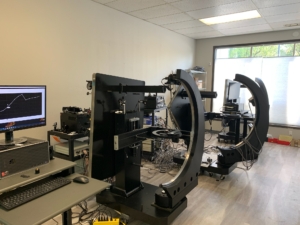 The TASC Scatterometer offers exceptional versatility for both reflective and transmissive hemispherical scatter measurements on horizontally mounted samples. This system utilizes light energy from lasers or broadband sources as a non-contact probe to measure scattered light from a wide range of materials, including liquids and powders. Additionally, the software options, such as point-to-point, in plane, raster, incident angle, bistatic and hemispherical integration, provide all the necessary tools for comprehensive material characterization.